 Deutsch
 English
 Español
 Français
 Italiano
 Português
 Русский
 中文
中文
Future-proof temperature control technology: 100% natural refrigerants from Huber
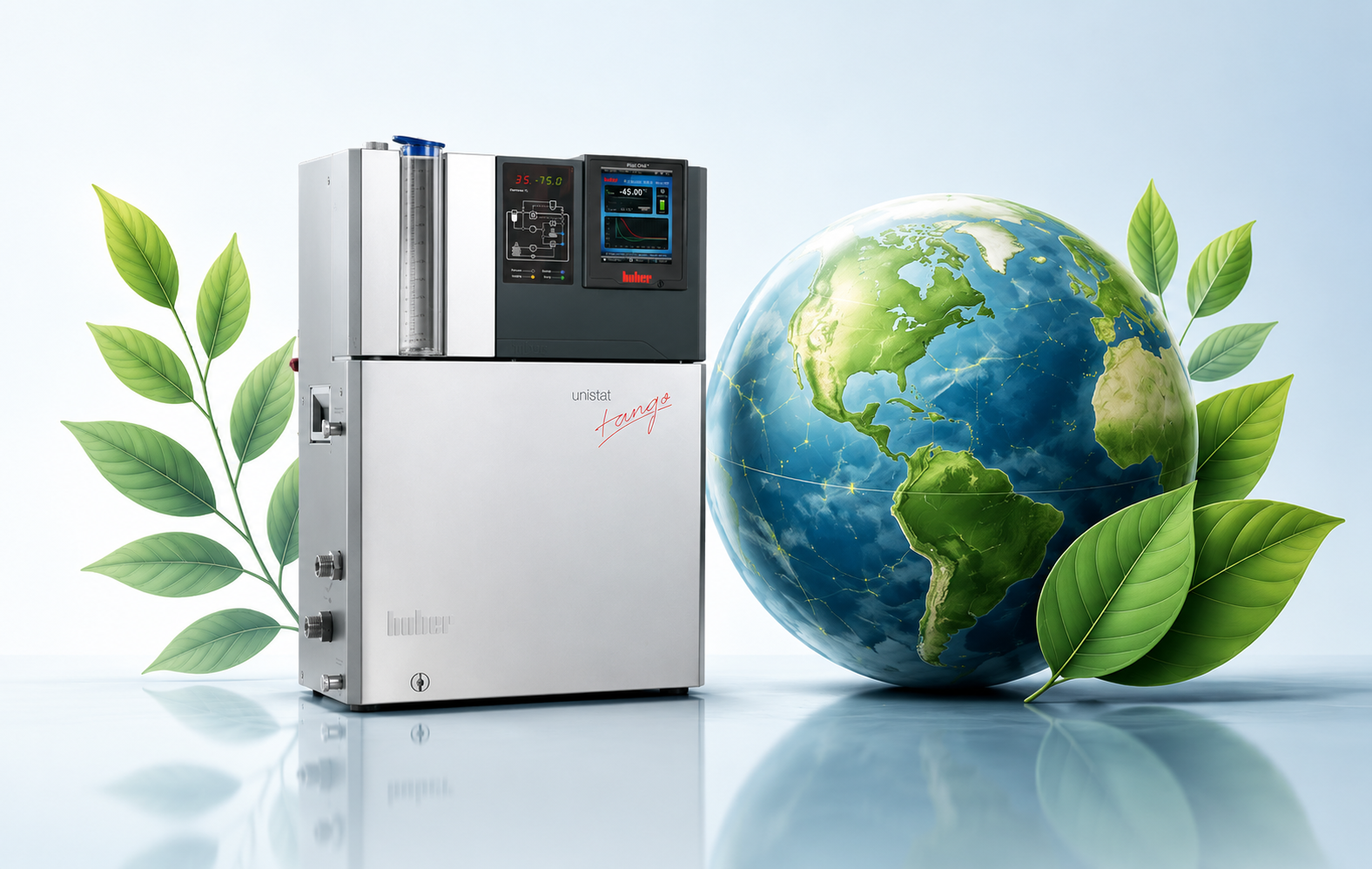
The Huber approach: Focusing on the system as a whole
When developing our sustainable ranges of equipment, we always take the entire system into account. In addition to selecting the optimal natural refrigerant (such as R290/propane or R744/CO₂), our focus is on energy-efficient refrigeration cycles, intelligent control technology and maximum durability.
Thanks to their outstanding thermodynamic properties, natural refrigerants enable particularly high-performance and energy-efficient refrigeration processes whilst minimising environmental impact.
Your benefits at a glance
- A 100% future-proof investment: unaffected by any future tightening of regulations or F-gas restrictions.
- No PFAS risk: Natural refrigerants do not form any harmful degradation products (forever chemicals) in the environment.
- Minimal environmental impact: Climate-friendly operation with GWP values ranging from 0 to 3.
- Excellent efficiency: Higher thermodynamic efficiency and reduced operating costs (Total Cost of Ownership).
- Long-term service reliability: Straightforward maintenance and repair thanks to refrigerants that are available in unlimited quantities worldwide.

Exception within the product range
In order to meet the specific technical and regulatory requirements of all sectors, the Huber portfolio currently includes the following exception, where synthetic refrigerant may continue to be used:
- Semiconductor industry (semiconductor manufacturing): Due to highly specific process requirements and global supply chains, temporary regulatory exemptions currently apply to this sector.
If you are planning an application in this area, our sales team will be happy to advise you individually on the available solutions.
A pioneering spirit since 1976 & Green Line
At Huber, sustainability is not a recent response to legislation, but a philosophy we have upheld for decades. As early as 1976, we launched our first units using natural refrigerants. Popular ranges such as Ministat, Minichiller, KISS/CC, Petite Fleur and Tango have been using environmentally friendly refrigerants for many years.
In addition, our Green Line series offers high-performance units using CO₂ (R744) as the refrigerant: Ozone Depletion Potential ( ODP) = 0, negligible Global Warming Potential ( GWP) = 1 and completely non-flammable – ideal for demanding laboratory and process environments.
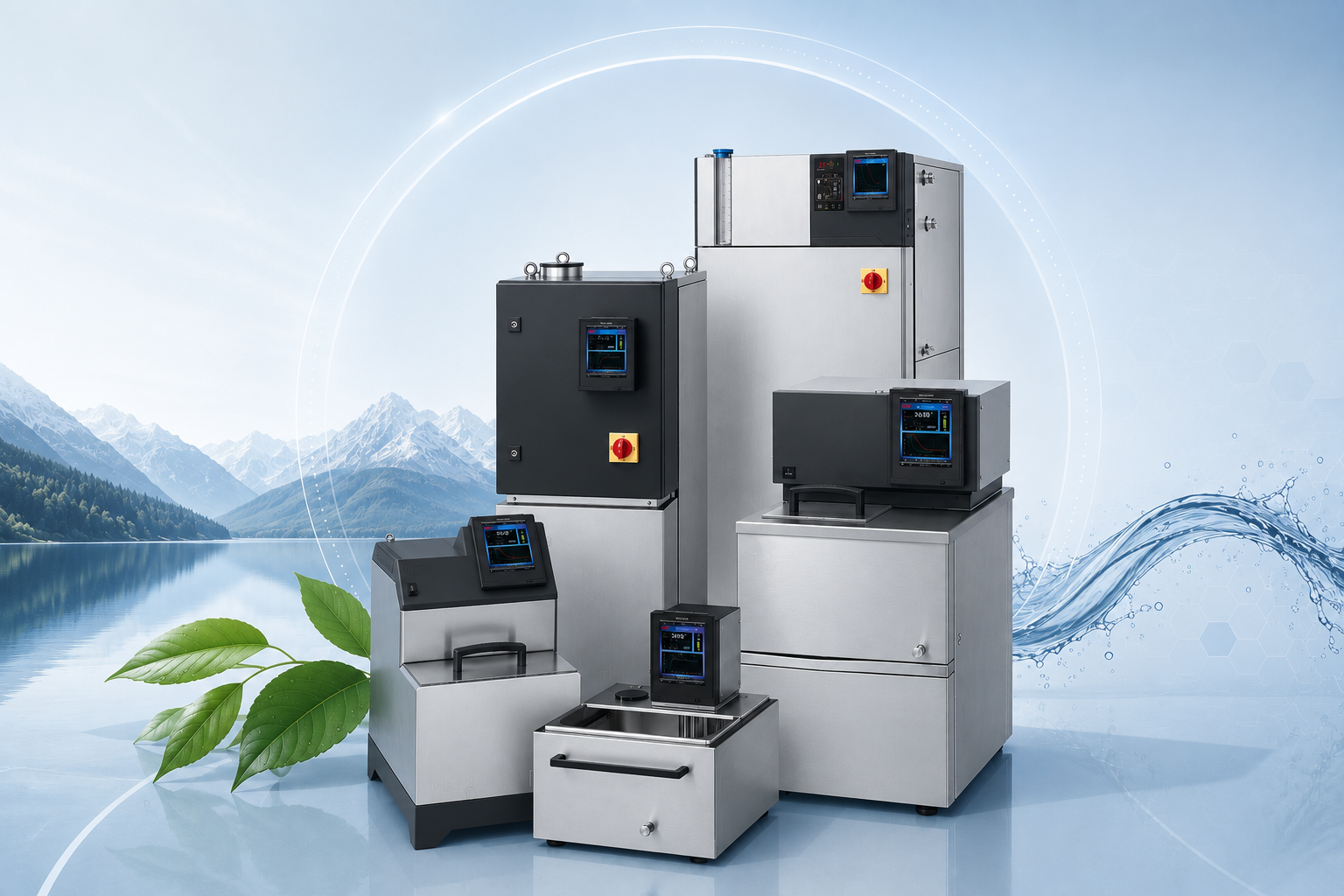
Legal background: EU Regulation (EU) 2024/573
The EU F-Gas Regulation, which came into force on 11 March 2024, provides for a phased reduction (‘phase-down’) of synthetic refrigerants by 2050. Whilst the legislator has granted a transition period until 1 January 2027 for liquid-circulating coolers and thermostats (Category 7) before the ban on F-gases takes effect, Huber has already fully completed the transition.
With Huber’s temperature control solutions, you are choosing a green, highly efficient and absolutely future-proof technology.
The technological and environmental difference
Whilst synthetic refrigerants (such as HFCs or HFOs) are artificially produced in laboratories and, when released into the atmosphere, act as greenhouse gases for decades, or leave behind halogenated degradation products (such as TFA/PFAS) in the environment, natural substances form part of the global material cycle.
Focus on the GWP value
The key indicator is the Global Warming Potential (GWP). It describes how much more a gas contributes to global warming over a 100-year period than carbon dioxide (CO₂, which has a reference GWP value of 1):
- Synthetic refrigerants: Often have GWP values ranging from over 1,300 to 3,900. A single kilogram of leaked refrigerant has as great an environmental impact as several tonnes ofCO2.
- Natural refrigerants: Have a GWP of almost 0 (e.g. propane with a GWP of 3 or CO₂ with a GWP of 1).
Safety and toxicity
Although synthetic gases are often considered to be highly flammable, they form highly toxic hydrofluoric acid in the event of a fire. Although natural refrigerants require precise equipment design due to their properties (flammability in the case of hydrocarbons, high pressure in the case of CO₂), they are chemically inert, non-toxic and, once released, do not contaminate either soil or groundwater.
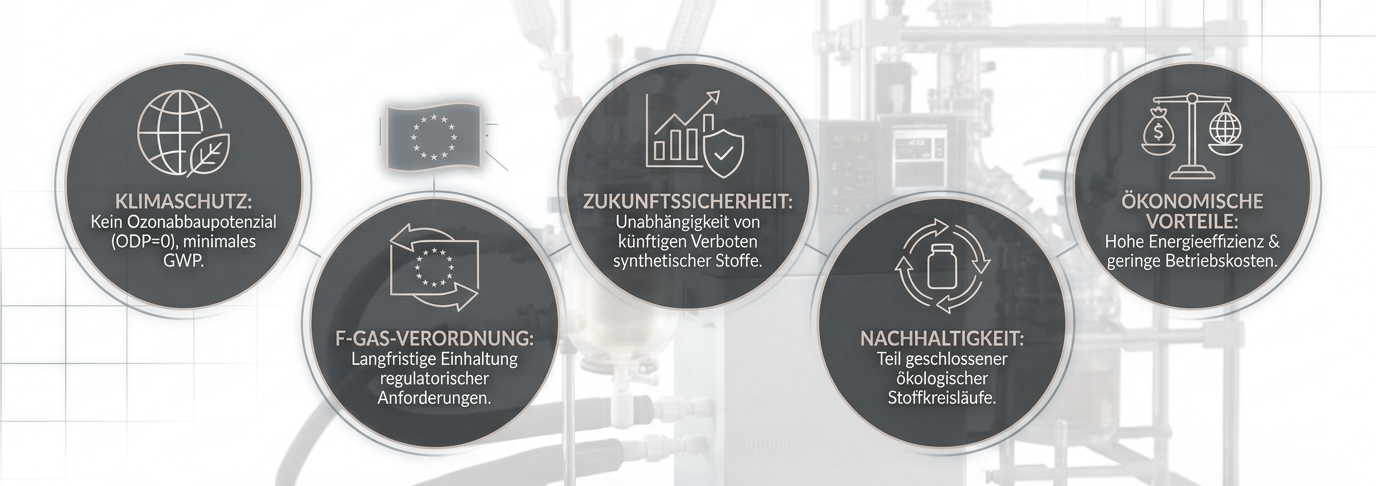
What natural refrigerants does Huber use?
Depending on the power range, application and required operating temperature, Huber’s engineers select the most suitable refrigerant from a thermodynamic perspective:
R290 (propane) – The highly efficient all-rounder
Propane has established itself as an excellent refrigerant for the small to medium capacity range. It has outstanding thermodynamic properties, ensures excellent compressor efficiency and enables very rapid heating and cooling.
R744 (CO₂) – The specialist for high capacity and low temperatures
Carbon dioxide is becoming increasingly important in the industrial sector. Thanks to its high volumetric efficiency, it enables extremely compact compressor stages whilst delivering very high cooling capacities in the medium and low temperature ranges. As it is completely non-flammable, it is perfectly suited to sensitive production environments.
Benefits for users:
- High energy efficiency: Systems using R290 or R744 often consume significantly less electricity than alternatives whilst delivering the same cooling capacity.
- Low operating costs: Lower energy consumption, combined with affordable, freely available refrigerants, reduces the total cost of ownership (TCO).
- Regulatory certainty: No obligation to carry out costly leak tests or provide special certification, as is required for many F-gases.
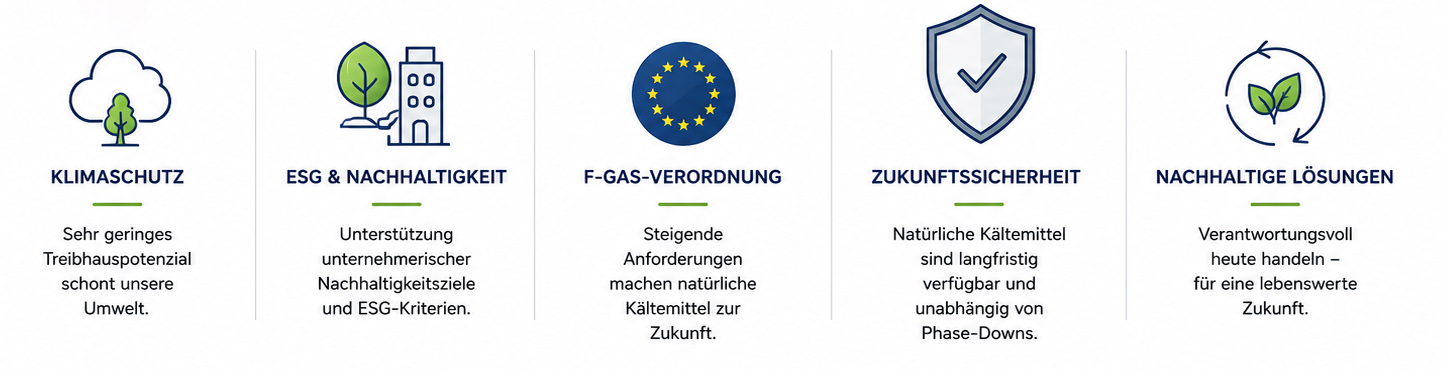
Natürliche und synthetische Kältemittel im Vergleich
In der industriellen Kältetechnik kamen in der Vergangenheit sowohl synthetische als auch natürliche Kältemittel zum Einsatz. Beide erfüllen die gleiche Aufgabe – den Transport von Wärme innerhalb eines Kältekreislaufs –, unterscheiden sich jedoch deutlich hinsichtlich ihrer Umweltwirkungen, regulatorischen Rahmenbedingungen und thermodynamischen Eigenschaften.
Synthetische Kältemittel, insbesondere fluorierte Kohlenwasserstoffe (HFKW), wurden über viele Jahre als Ersatz für ozonschädigende Stoffe entwickelt und weltweit eingesetzt. Einige dieser Kältemittel besitzen jedoch ein hohes Treibhauspotenzial (Global Warming Potential, GWP). Aus diesem Grund werden sie im Rahmen der europäischen F-Gas-Verordnung schrittweise eingeschränkt.
Natürliche Kältemittel wie Propan (R290), Kohlendioxid (R744), Ammoniak (R717) oder Wasser (R718) zeichnen sich dagegen durch ein sehr niedriges GWP aus. Sie gelten als besonders klimafreundlich und bieten gleichzeitig hervorragende thermodynamische Eigenschaften. Je nach Anwendung ermöglichen sie zudem einen energieeffizienten Betrieb und leisten damit einen Beitrag zur Reduzierung des Energieverbrauchs.
Die Wahl des geeigneten Kältemittels hängt stets von den technischen Anforderungen der jeweiligen Anwendung ab. Neben dem Temperaturbereich spielen unter anderem Kälteleistung, Energieeffizienz, Sicherheitsanforderungen, Installationsbedingungen sowie wirtschaftliche Aspekte eine wichtige Rolle. Deshalb entwickelt Huber Temperierlösungen, bei denen das eingesetzte Kältemittel optimal auf die jeweilige Geräteklasse und den vorgesehenen Einsatzbereich abgestimmt ist.
Kältemittel im direkten Vergleich
| Eigenschaft | Natürliche Kältemittel | Synthetische Kältemittel |
| Treibhauspotenzial (GWP) | sehr niedrig | je nach Kältemittel teilweise hoch |
| Regulatorische Zukunftssicherheit | sehr hoch | zunehmend eingeschränkt |
| Energieeffizienz | häufig sehr gut | gut bis sehr gut |
| Umweltverträglichkeit | sehr hoch | abhängig vom Kältemittel |
| Langfristige Verfügbarkeit | hoch | teilweise durch gesetzliche Vorgaben begrenzt |
| Typische Beispiele | R290, R744, R717, R718 | R134a, R404A, R410A, R452A usw. |
FAQ (Frequently Asked Questions)
Why are F-gases being phased out?
Fluorinated greenhouse gases (F-gases) have a very high global warming potential and remain in the atmosphere for a very long time. To curb global climate change, legal requirements (such as the F-gas Regulation) drastically restrict their use and mandate a switch to environmentally friendly alternatives.
Is propane (R290) safe to use as a refrigerant in the laboratory?
Yes, absolutely. Thanks to modern, hermetically sealed refrigeration circuits, minimal charge quantities and the certified safety concept developed by Huber (separation of electronics and gas, integrated ventilation), operation in the laboratory is just as safe as with conventional systems.
What are the advantages of CO₂ (R744)?
CO₂ is neither flammable nor toxic (safety class A1). It also offers excellent volumetric cooling capacity, which enables extremely compact components whilst maintaining high energy efficiency in deep-freeze applications.
Are natural refrigerants just as efficient as synthetic ones?
In most cases, they are actually even more efficient! Due to their favourable thermodynamic properties (such as high specific heat of vapourisation), the compressors require less energy to deliver the same cooling capacity.
Do I absolutely have to convert my existing synthetic system straight away?
No, existing systems are covered by grandfathering provisions. Furthermore, directly ‘converting’ an old system to a natural refrigerant is usually not technically possible, as compressors, oils and seals must be specifically designed for the respective gas. However, for new installations, you should opt for natural refrigerants straight away to avoid future shortages and bans.
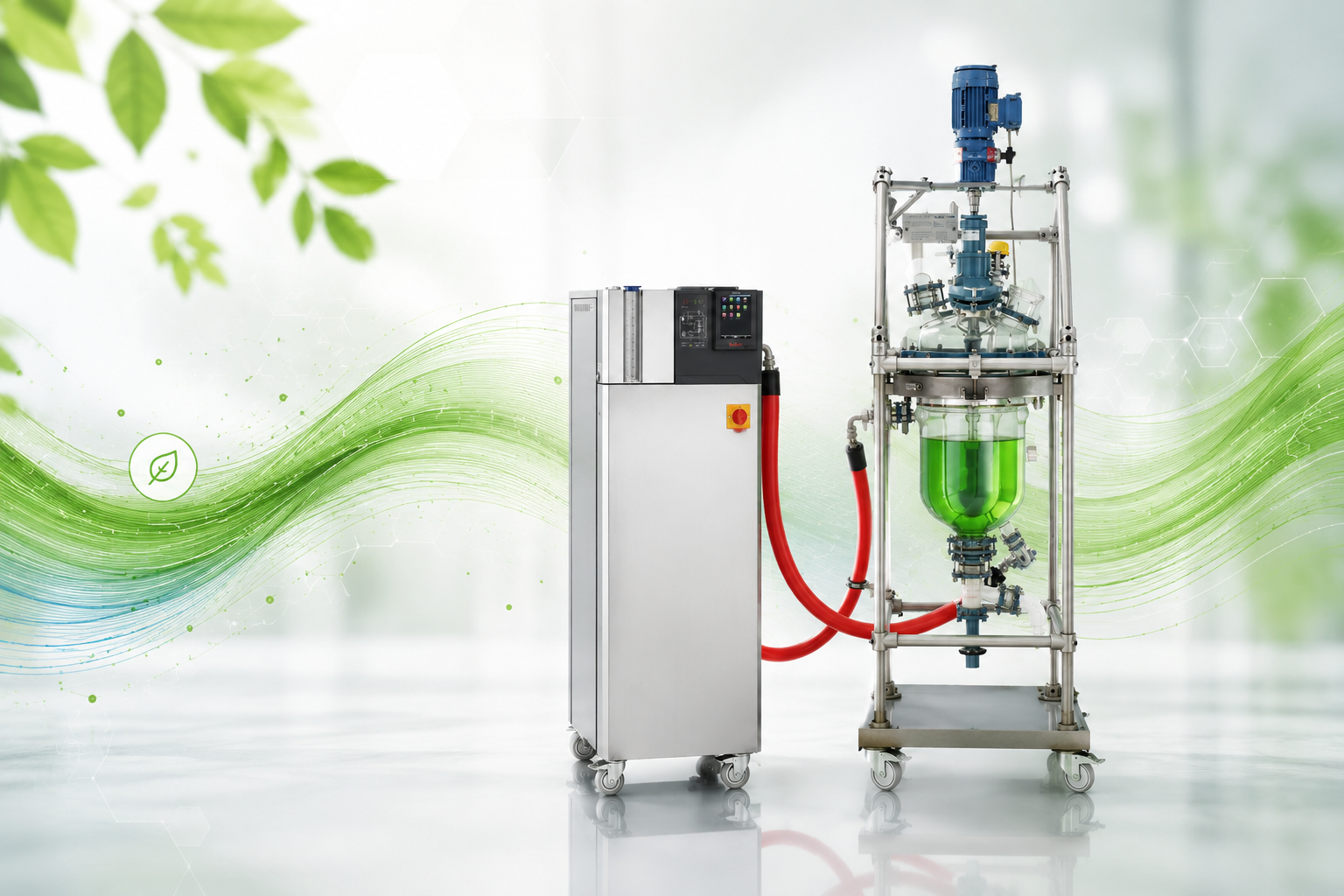
Towards a green future together
Are you planning a new project, or would you like to make your laboratory and production processes more sustainable? Our experts will help you choose the best products and calculate the appropriate cooling capacity for your application.
- Expert advice: Find out in a one-to-one consultation which refrigerant is best suited to your process requirements.
- Bespoke engineering: Do you have any special requirements? Our design engineers will tailor safety concepts and equipment ranges to your specific needs.