Deutsch
 English
 Español
 Français
 Italiano
 Português
 Русский
 中文
50 Years of Ministate – a small idea with a great history
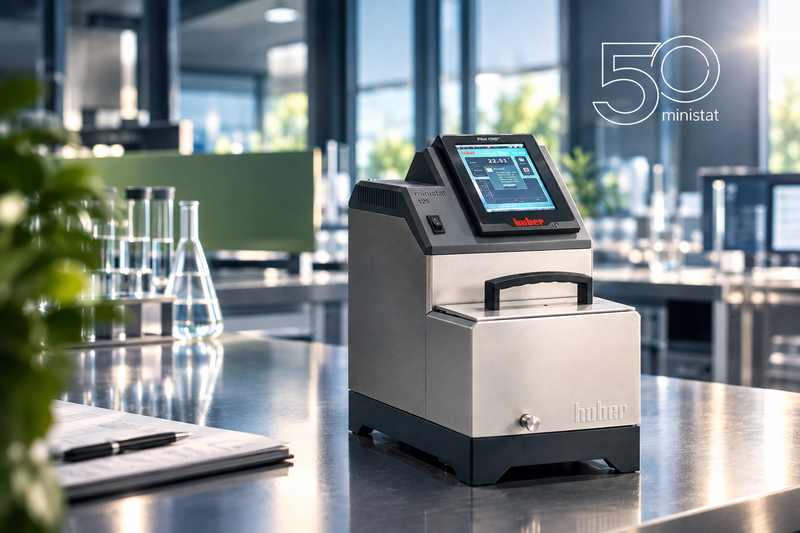
What does it take for a product to last for 50 years?
A good idea. Technical expertise. And, above all, the courage to constantly rethink that idea.
In 1976, Peter Huber launched the Ministat. As the smallest cooling thermostat in its class, it was exceptionally compact and powerful for its time. What began back then as a small device has developed into a product story that can now look back on 50 years of innovation, development and experience.
The aim was clear from the outset: high-performance temperature control in the smallest of spaces. The Ministat was intended to demonstrate that a cooling/heating thermostat does not have to be large to deliver great performance.
But the real success story only began after that.
After all, technology never stands still. Requirements change, new technologies emerge and experience gives rise to new ideas. The Ministat, too, has therefore been continuously refined over the years – without ever losing sight of its original concept.
As early as 1980, Huber introduced interchangeable digital controllers for laboratory thermostats. Further technical solutions were added. These include, amongst others, the automatic compressor shut-off and cooling capacity adjustment. Developments such as the capillary tube heating or the passive cooling of the peripheral zones in the stainless steel Ministat bath also demonstrate just how much development work goes into a comparatively small device.
Some of these solutions are barely noticeable at first glance. Yet this is precisely where a significant part of the Ministat’s history lies: innovation does not always have to look spectacular. Sometimes it lies in a detail that makes a device more precise, efficient or reliable.
Over the decades, new generations of the Ministat have thus emerged. A look at the units from different years reveals this evolution: the housing, operation and technology change – but the fundamental concept remains the same.
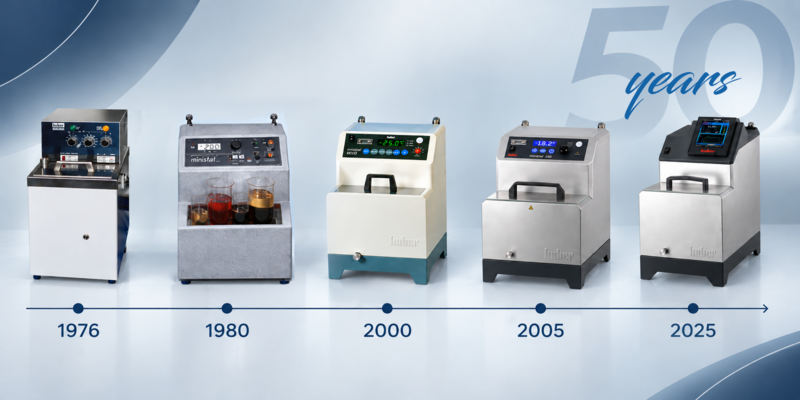
As much temperature control technology as possible in as little space as possible.
The Ministat wasn’t simply reinvented time and time again. It was developed further. Proven features were retained, new technologies were integrated, and practical experience was incorporated into the next generation.
That is precisely what makes the history of the Ministat so special. Successfully developing a product over 50 years does not mean clinging to an original solution. It means constantly putting it to the test – whilst at the same time recognising what lies at its very heart.
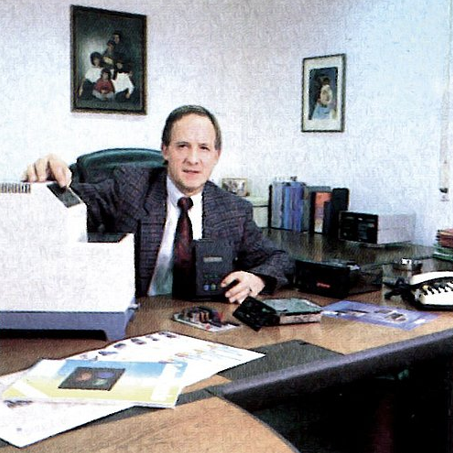
The history of the Ministat is closely linked to Peter Huber. As its founder and developer, he shaped the company and, with the Ministat in 1976, laid the foundation for a product history that continues to this day.
Peter Huber passed away in 2018. The idea that began in 1976 with the Ministat has endured.
And perhaps that is precisely what makes this anniversary so significant: a good idea does not have to remain unchanged to stand the test of time. It must be able to evolve.
In 2026, the Ministat will look back on 50 years of product history.
50 years in which technologies have changed.
50 years in which new requirements have emerged.
50 years in which a small idea has repeatedly given rise to new technical solutions.
From the very first Ministat to today’s generations, one thing has remained constant: the commitment to delivering compact, high-performance and precise temperature control technology.
Perhaps that is the real success story of the Ministat.
Not that a product has remained the same for 50 years.
But rather that it has been able to evolve over 50 years whilst remaining true to its original concept.
In 1976, the story began with a small idea.
In 2026, we will look back on 50 years of development.
And the story of the Ministat is not yet over.